
AI · WEBSITES · SALES
Let’s grow your business.
I design websites, implement AI and build team skills, to make work easier and support sales.

01 / SCOPE OF WORK
Where we start
and what follows.
Three of the areas form a sequence - each builds on what came before. We can join at any point, but it helps to know what follows what.
- AI audit You know where to start, and why. I look at where AI can genuinely help your organisation. Together with your team we choose the use cases worth implementing and testing in practice. Result: specific improvements and an agreed way to measure their value. See details →
- AI implementation A solution tested on your own work. I build and launch the solution, then test it on your team’s real tasks and compare the result with the starting point. Result: a tool in daily use and a team that manages without me. See details →
- Training Skills for everyday work. We work on the tasks your team meets every day. Participants learn to use the tools deliberately and on their own. Result: skills your team can use the day after the workshop. See details →
Independent of the AI path
These two do not require AI.
They round out the path above, but they do not need it. You can order just a website or just the brand work and stop there. If we do them alongside an audit, they build on what I already know about your company - but that is convenience, not a condition.
02 / WHERE TO START
Find your situation.
Five sentences I hear most often. Pick the one that sounds familiar - it leads to the scope that answers it.
- Your team repeats the same steps and you suspect they could be shorter. Scope AI audit
- Company knowledge is scattered across drives and inboxes, so the tools answer in generalities. Scope AI implementation
- You rolled out a tool but people went back to the old way of working. Scope Training
- You have a website but it brings no enquiries - or only random ones. Scope Websites
- You do several things at once and struggle to explain in one sentence what you do. Scope Brand and image
None of them fits? That is an answer too - write to me and describe it in your own words. Get in touch →
03 / HOW I WORK
You know what to expect.
On both sides.
Working together takes four steps. At each one you see what I do and what I need from you - so nothing comes as a surprise halfway through.
-
Discovery
2-3 h of interviews
On my side
I talk to the people doing the work, not only to the decision maker. I describe the process as it actually runs and measure the starting point.
On your side
You make 2-3 hours available from the people who do the work - not only your own.
-
Solution design
before we build
On my side
I establish exactly how it should work: what goes in, what comes out and who uses it. I choose a tool with a rationale and write out what it will not do.
On your side
You name one person responsible on your side and approve the scope.
-
Pilot and measurement
4-6 weeks
On my side
I put the solution to work and test it on your real tasks. I compare the result against the measured starting point.
On your side
You give real tasks, not sample ones, and say plainly what does not work.
-
Handover to the team
at delivery
On my side
I hand over role-based instructions and rules for checking AI answers.
On your side
You decide whether we go further - based on the result, not on a declaration.
Roughly on your side: 4-6 hours across the whole project. See the audit step by step →
04 / PRINCIPLES
What I do not promise
and what I give instead.
This is not a list of shortcomings. These are the limits I set at the start, so that there is no disappointment at the end.
-
I do not promise
A guaranteed search ranking
Nobody can honestly promise one.
Instead
I am responsible for structure, copy, speed and measurement - what genuinely depends on the site.
-
I do not promise
A promise of "X percent growth"
A declaration without data is only a declaration.
Instead
A measured starting point and a measurement method. I call estimates estimates and write out the assumption behind them.
-
I do not promise
Implementation without discovery
A use case with no data behind it is an idea, not a recommendation.
Instead
Discovery of the process first. If AI adds nothing to your process, I will say so plainly.
-
I do not promise
Dependence on me afterwards
An implementation that leaves everyone calling me is a failed one.
Instead
Role-based instructions and rules for checking answers. Your team is meant to work on its own.
05 / ABOUT
Technology built
around people.
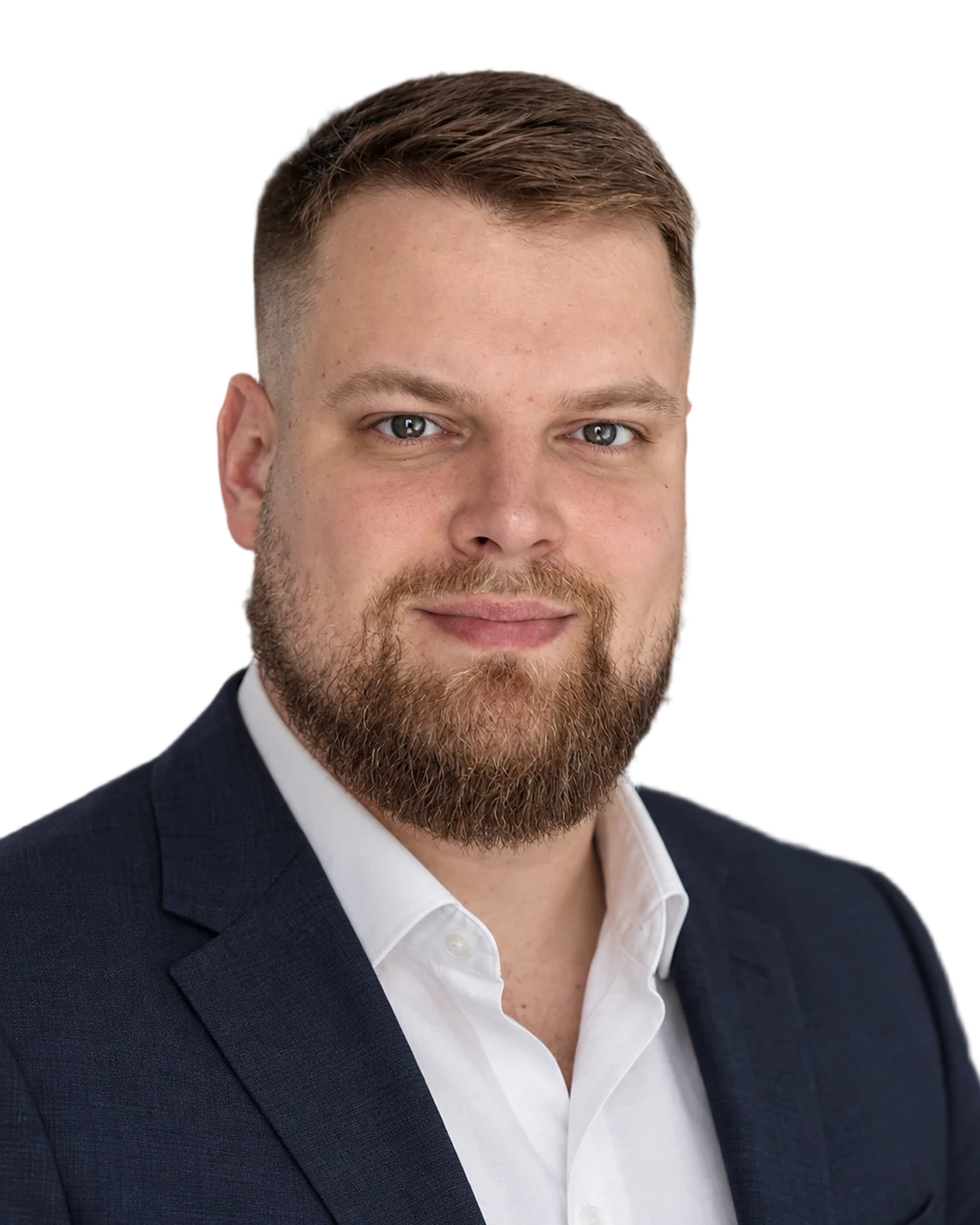
Companies usually reach me at one of two moments. Either someone tried AI on their own and it ended as a curiosity, or there is pressure to "do something about it" without a clear place to start.
In both cases the first step is the same: understand how the work really runs. I want new tools to give teams more independence, not less.
-
Working together
You work with me directly. I do not subcontract and I do not hand the project to an account manager.
-
Discovery
I talk to the people doing the work, not only to the decision maker. The gap between those accounts is usually the most interesting part.
-
Afterwards
Every implementation ends with role-based instructions and rules for checking answers.
06 / INSIGHTS
Practical articles
on adopting AI.
No promises, with the conditions nothing works without. Read them before you write - it will be easier for us to start with specifics.



07 / COMMON QUESTIONS
Before you write,
the answer may be here.
Nine questions I hear most often on a first call. If yours is not here, just ask - you will get an equally specific answer.
We do not know whether AI is of any use to us. Where do we start?
With discovery, not with a tool. I talk to the people who do the work, not only to the decision maker, and I measure the starting point - how long the key steps take today. If discovery shows that AI does nothing for your process, I will say so plainly. Better to learn that after discovery than after an implementation.
How much of our time will it take?
Discovery needs 2-3 hours of conversations, plus an hour together to set the scope of the pilot. The rest is my own work. The pilot itself usually runs 4-6 weeks, but that is time spent watching the solution in daily work, not your involvement. Meetings can be remote or at your office - whichever suits you.
Do you only work locally, or with companies across Poland?
With companies across Poland. The first call is always online - that is enough to understand the situation and see whether and how I can help. Later meetings, conversations with the team and workshops can take place at your office, anywhere in Poland, or remotely - whichever suits you.
How much does it cost?
I quote after a conversation, because it depends on the scope. There is no price range here, because such a number says nothing until it is clear what needs doing. The proposal shows the modules, the result of each one and the final price - with no "to be agreed later" line items. A proposal is valid for 30 days.
Will we have to buy additional tools?
Usually yes, and I say so plainly in the proposal. Subscriptions, licences, hosting and domains are paid by your company and are excluded from the price of my work - so you can see what goes to me and what goes to the tool vendor. When choosing a tool I write down the reasoning together with the cost, so it can be compared with the alternative.
What about our data and our clients data?
Use cases that touch personal data are flagged at the use-case map stage and revisited at implementation. I sign an NDA, and where I process data on your behalf - a data processing agreement. This does not replace legal advice and I do not pretend otherwise.
Will we be left on our own afterwards?
No, and that is deliberate. An implementation ends with instructions written for specific roles and with rules for checking what the AI returns. The team is meant to work on its own, not to call me with every question. I only propose ongoing care after the pilot is accepted, when it is clear there is something worth looking after.
Do we have to order everything at once?
No. The areas are independent, and the audit - implementation - training path runs in that order only because each step builds on the result of the previous one. We start with one area, and after it you decide whether we go further.
How does payment work?
Payment terms are 14 days. On larger projects I ask for a deposit before the start and split the rest into instalments tied to the acceptance of each stage - you pay for what has been accepted, not for everything up front.
08 / Let's talk
What would you like to improve in your company?
A phone call is the fastest way - the first conversation matters most, because I can ask straight away about what actually counts. Prefer to write? That works too.
Call780 890 568
Send me an emailpawel@sobczakai.com
Where I workAll of PolandThe first call is always online. After that I can come to your office.
What happens next
I get back to you and ask about whatever I still need to understand the situation.
We book a short online call, usually 30-45 minutes. No slide deck, just questions about your process.
You get a proposed scope with a quote and a description of what the scope does not cover.
Prefer me to call you back?
Leave your details and I will call. I need nothing more at this stage.
I use this data only to call you back and prepare a quote. Details are in the privacy policy.